
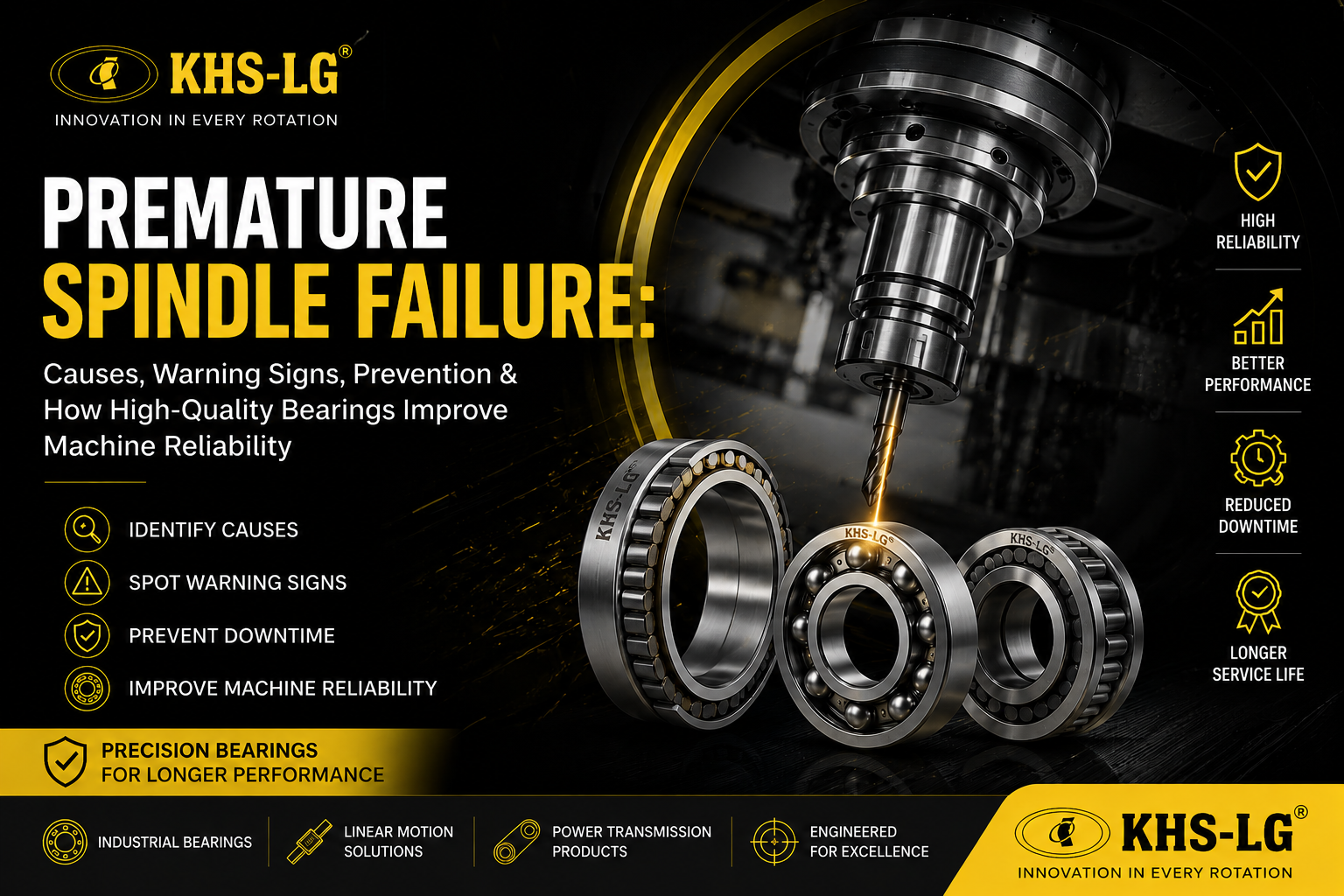
If you’ve spent any time on a shop floor, you already know the spindle is not “just another component.” It’s the part of the machine that actually does the work — holding the tool or workpiece, running at thousands of RPM, and translating motor power into accuracy on the part. Everything else on a CNC machine, grinder, or motor-driven assembly exists to support what happens at the spindle.
Which is exactly why a spindle failure hurts more than almost any other breakdown. A failed ball screw or a worn linear guide will usually give you days of warning and a few hours of downtime to fix. A spindle that seizes mid-shift can mean a scrapped part, a damaged tool holder, a multi-day repair or rebuild, and in machining shops running tight delivery schedules, a missed customer commitment. Spindle rebuilds on mid-size CNC machining centers routinely run into five figures once you account for the bearing set, precision regrind of the housing bore, balancing, and lost production time. On grinding spindles and high-speed electrospindles, the number climbs further because the tolerances involved are tighter and the repair options are fewer.
Here’s the part that’s easy to miss: in the overwhelming majority of cases, spindle failure isn’t really a “spindle problem” at all. It’s a bearing problem. The spindle shaft, housing, and motor rarely fail on their own — they fail because the bearings supporting them broke down first, and everything downstream followed. That’s why this article spends as much time on bearing engineering as it does on the spindle itself.
In this guide, we’ll walk through what premature spindle failure actually is versus normal end-of-life wear, the eleven most common root causes we see in industrial and machine-tool applications, the warning signs that show up before catastrophic failure, and the practical maintenance and bearing-selection decisions that determine whether your spindles last 20,000 hours or 200,000.
Table of Contents
- What Is Premature Spindle Failure?
- Why Does Premature Spindle Failure Happen?
- Common Causes of Premature Spindle Failure
- Warning Signs of Premature Spindle Failure
- How High-Quality Bearings Reduce Spindle Failure
- Choosing the Right Precision Bearings
- Preventive Maintenance Tips
- Best Practices to Extend Spindle Life
- Frequently Asked Questions
- Conclusion
- About KHS LG
What Is Premature Spindle Failure?
A spindle bearing arrangement, like any rolling bearing, has a calculated theoretical life — the L10 basic rating life defined under ISO 281. In plain terms, L10 is the number of revolutions (or operating hours) at which 90% of a large batch of identical bearings, run under identical, ideal conditions, would still be functioning without fatigue damage. It’s a statistical figure used for design purposes, not a promise about any individual bearing.
Premature spindle failure is when a spindle goes down well before it reaches that calculated life — and almost always for a reason that has nothing to do with normal material fatigue. The L10 calculation assumes a specific set of conditions: correct lubrication, clean operating environment, correct mounting, and no inherent material defects. The moment any one of those assumptions is violated, the real service life can drop to a fraction of the calculated number. A spindle rated for 30,000 hours of continuous duty can fail in under 2,000 hours if contamination gets past a worn seal, or if preload was set incorrectly during a rebuild.
This is different from normal wear-out, which looks like this: a spindle runs for years, gradually accumulates subsurface fatigue on the raceways as designed, and eventually shows classic fatigue spalling near or after its calculated life. That’s expected, plannable, and not a failure in the engineering sense — it’s the bearing doing exactly what it was designed to do.
Premature failure, by contrast, almost always traces back to an external or avoidable factor: a contamination ingress point, a lubricant that broke down chemically, a thermal mismatch during installation, an overload event, or a bearing that was never suited to the application’s speed and load profile in the first place.
The distinction matters operationally. If your spindles are failing at or near their rated life, that’s a maintenance scheduling problem — plan replacements proactively. If they’re failing well before rated life, that’s a root-cause problem, and no amount of “tighter maintenance scheduling” will fix it until the actual cause is identified and corrected.
In industrial machinery generally — pumps, gearboxes, conveyor drives, and machine tool spindles alike — the spindle (or main shaft bearing arrangement) is usually the single point of failure with the highest consequence-to-probability ratio. It doesn’t fail often, but when it does, it tends to take the most expensive path to repair.
Why Does Premature Spindle Failure Happen?
If there’s one mistake we see repeatedly when shops investigate a spindle failure, it’s looking for a single smoking gun. In reality, premature spindle failure is almost always the end result of two or three contributing factors stacking on top of each other.
A spindle bearing rarely fails because lubrication was “a little off.” It fails because lubrication was marginal and the seal had started to wear and the shop ran the spindle a notch faster than the application called for. Remove any one of those three factors and the bearing might have survived years longer.
This is consistent with what bearing manufacturers’ own root-cause failure analysis programs report. SKF’s bearing failure analysis training, for example, groups the vast majority of premature failures into a handful of categories: poor fitting, poor lubrication, contamination, and fatigue — and notes explicitly that calculated bearing life assumes ideal lubrication, undamaged mounting, correct dimensions, and no inherent defects. Violate any of those four assumptions and you’re no longer looking at a fatigue-driven failure; you’re looking at a preventable one.
The practical categories worth thinking through, every time a spindle goes down, are:
- Bearing quality — was the bearing manufactured to the tolerance grade the application actually needs?
- Lubrication — correct type, correct quantity, correct interval, no contamination of the lubricant itself?
- Installation — correct preload, correct fits, correct alignment, no shock loading during mounting?
- Operating conditions — is the spindle running within its rated speed and load envelope, or has the application crept beyond what it was specified for?
- Maintenance — is anyone actually tracking temperature, vibration, and running hours, or is maintenance purely reactive?
- Environment — coolant, chips, humidity, dust, and temperature swings in the surrounding work area.
Treat a spindle failure investigation like a checklist across all six, not a search for the one cause. That’s the approach that actually prevents the next failure, rather than just explaining the last one.
Common Causes of Premature Spindle Failure
Poor Quality Bearings
Why it happens: Not all bearings carrying the same bore and OD dimensions are equivalent. Raceway surface finish, material cleanliness, heat treatment consistency, and dimensional tolerance all vary between manufacturers — and between a genuine precision-grade bearing and a generic substitute sold on dimension alone.
Engineering reason: Subsurface inclusions in the bearing steel, inconsistent hardness, or raceway waviness all reduce the actual fatigue life far below the catalogue L10 figure, because the ISO 281 calculation assumes defect-free material. A bearing with poor surface finish also generates a thicker, less stable lubricant film boundary, which increases asperity contact and accelerates wear from day one.
Symptoms: Shorter-than-expected service life across multiple installations of the same bearing position, inconsistent runout between supposedly identical units, early-stage spalling that doesn’t match the load history.
Prevention: Source bearings from manufacturers who can demonstrate traceable material and tolerance control, and match the precision grade (see the ABEC/ISO P-class discussion below) to the actual demands of the application rather than buying to the lowest delivered price.
Improper Lubrication
Why it happens: Under-greasing, over-greasing, wrong grease type, wrong oil viscosity, or lubricant that’s simply been left in service too long.
Engineering reason: Rolling bearings depend on a continuous elastohydrodynamic lubricant film to separate the rolling elements from the raceway. Too little lubricant and that film breaks down, leading to metal-to-metal contact, surface distress, and rapid heat generation. Too much lubricant — particularly with grease — causes excessive churning, which raises operating temperature and can be just as damaging as starvation. Oil viscosity also has to be matched to speed and temperature: too thin at operating temperature and the film thickness collapses; too thick and you generate unnecessary friction and heat at startup.
Symptoms: Gradual temperature rise during a shift, grease discoloration or burnt smell on relubrication, increased running noise, premature surface distress on inspection.
Prevention: Follow the bearing manufacturer’s lubricant specification exactly — type, quantity, and relubrication interval — and verify with periodic oil analysis or grease sampling rather than assuming the schedule is being followed correctly.
Contamination
Why it happens: Coolant, metal chips, abrasive dust, or moisture entering the bearing cavity through worn seals, inadequate air purge systems, or compromised housings.
Engineering reason: Even particles a few microns in size can be larger than the elastohydrodynamic film thickness separating the rolling elements from the raceway. When a hard particle gets rolled into that contact zone, it indents the raceway, and that indentation becomes a stress riser that initiates fatigue cracking far earlier than the material itself would otherwise allow. In machine-tool applications, contamination is frequently cited as the leading single cause of premature bearing failure — some spindle repair specialists put it at roughly 80% of cases when poor air supply and ingress are included. Whether or not the exact percentage holds for every application, the directional point is solid: clean is not optional.
Symptoms: Fine scoring or denting on raceways and rolling elements during teardown, gritty or discolored grease, accelerated wear concentrated near seal locations.
Prevention: Maintain seal condition as a scheduled maintenance item (not just a “replace when it leaks” item), use positive air purge on high-speed spindles exposed to coolant or dust, and control the cleanliness of the air supply feeding that purge system — a contaminated air line defeats the purpose of the purge entirely.
Misalignment
Why it happens: Shaft-to-housing misalignment, angular misalignment between coupled components, or distortion introduced during assembly or after a crash event.
Engineering reason: A correctly aligned bearing distributes load evenly across the full width of the raceway and across all loaded rolling elements. Misalignment concentrates load onto one edge of the raceway or onto a smaller number of rolling elements, which dramatically increases localized contact stress. Because fatigue life is inversely related to load by a power of roughly three (for ball bearings) under ISO 281, even a modest increase in localized stress translates into a much larger reduction in usable life.
Symptoms: Uneven wear pattern across the raceway width on inspection, elevated vibration at running speed, edge loading visible as a band offset from bearing centerline.
Prevention: Check shaft and housing geometry against tolerance before every bearing installation, use proper alignment tools rather than judging “by feel,” and always re-verify alignment after any repair that involved removing the spindle from its housing.
Overloading
Why it happens: Operating beyond the rated load — through aggressive cutting parameters, oversized tooling, machine crashes, or simply specifying an application incorrectly at the design stage.
Engineering reason: Because the load-life relationship is cubic for ball bearings (and close to it for roller bearings), even a 20–25% increase in actual load above design load can cut calculated life by close to half. Shock loads from crashes are worse still — they can produce instantaneous Hertzian contact stresses that cause brinelling (visible indentations) on the raceway, which then act as fatigue initiation points for the remainder of the bearing’s service.
Symptoms: Localized indentations on the raceway (visible without magnification in severe cases), sudden increase in vibration or noise following a specific event, runout that wasn’t present before a crash.
Prevention: Respect the rated load envelope of the bearing arrangement, build in crash-protection logic on CNC controls where available, and treat any crash event as a mandatory inspection trigger rather than something to “run and see.”
Excessive Heat
Why it happens: Lubrication breakdown, incorrect preload, friction from contamination, inadequate cooling system performance, or running speeds beyond the bearing’s thermal limit.
Engineering reason: Bearing steel and grease both have practical operating temperature ceilings. Beyond those limits, grease oxidizes faster and loses its film-forming properties, and the bearing’s internal clearances change as components expand at different rates, which can convert a correctly set preload into an excessive one — generating still more heat in a feedback loop. Sustained operation above the rated temperature also reduces the dimensional stability of hardened bearing steel over time.
Symptoms: Housing temperature noticeably above baseline, discoloration (bluing) of bearing components on inspection, grease that has hardened, darkened, or developed a burnt odor.
Prevention: Monitor spindle temperature as a routine parameter (not just “touch the housing”), verify cooling system performance on liquid-cooled spindles, and investigate any sustained temperature increase immediately rather than waiting for an alarm threshold.
Improper Installation
Why it happens: Incorrect mounting force, using a hammer or improvised tooling instead of proper induction heaters or hydraulic mounting tools, incorrect interference fit, or skipping cleanliness procedures during assembly.
Engineering reason: Bearings are precision components, and the rolling elements and raceways can be damaged by shock loads transmitted through the rings during mounting — even if the damage isn’t visible immediately. Incorrect interference fit (too loose or too tight) changes internal clearance from the design value, which affects both load distribution and thermal behavior.
Symptoms: Early-life failure (within days or weeks of installation) with damage patterns inconsistent with normal operating wear, brinelling on the raceway matching the spacing of the rolling elements, fretting at the bearing seat from a fit that’s too loose.
Prevention: Train installation technicians on correct mounting procedures and tooling, use induction heaters for interference-fit mounting rather than direct heat or force, and treat bearing handling and storage cleanliness as part of the installation procedure, not an afterthought.
Incorrect Bearing Selection
Why it happens: Specifying a bearing based on bore and OD match alone, without verifying that its speed rating, load rating, internal design (contact angle, ball complement), and precision grade actually fit the application.
Engineering reason: A deep groove ball bearing and an angular contact bearing with the same envelope dimensions behave very differently under combined radial and axial load, and have very different limiting speeds. Selecting the wrong bearing type — or the right type at the wrong precision grade — sets up a mismatch between what the application demands and what the bearing was designed to deliver, regardless of installation or maintenance quality.
Symptoms: Consistent underperformance across an entire fleet of otherwise well-maintained machines, premature wear that correlates with a specific bearing part number rather than a specific machine.
Prevention: Select bearings against the full application profile — speed, combined load direction, required stiffness, operating temperature, and required running accuracy — rather than against bore size alone, and consult catalogue limiting-speed and load data rather than assuming “it fits, so it works.”
Vibration
Why it happens: Tool or rotor imbalance, worn tool holders, resonance with structural natural frequencies, or — critically — vibration that is itself a symptom of an already-damaged bearing, not just a cause of future damage.
Engineering reason: Vibration imposes dynamic, often high-frequency loading on top of the bearing’s static load, accelerating fatigue and disturbing the lubricant film. It’s also one of the most useful diagnostic signals available, because rolling bearings generate characteristic defect frequencies as they deteriorate (related to ball pass frequency on the inner and outer races, and rolling element spin frequency), which is the basis of vibration-based condition monitoring per standards such as ISO 10816 / ISO 20816 for evaluating mechanical vibration severity.
Symptoms: Audible or measurable vibration increase at running speed, poor surface finish on machined parts, tool chatter, dimensional inaccuracy that wasn’t present previously.
Prevention: Balance tooling and rotating assemblies correctly, run periodic vibration analysis as part of a predictive maintenance program rather than waiting for audible symptoms, and investigate any vibration trend change immediately — it’s almost always cheaper to act on a trend than to wait for a failure.
Thermal Expansion
Why it happens: Rapid temperature changes — fast warm-up at the start of a shift, fast cool-down after shutdown, or large temperature swings between ambient and operating conditions.
Engineering reason: Spindle components expand and contract at different rates depending on material and mass distribution. If a spindle is run up to operating temperature too quickly, components may not expand uniformly, which can momentarily increase preload beyond design intent. Cooling down too fast, particularly in humid environments, risks internal condensation, which introduces moisture-related corrosion risk inside the bearing cavity.
Symptoms: Inconsistent dimensional accuracy that correlates with time-of-day or shift start rather than tool wear, light surface corrosion (fretting/rust) found during inspection despite otherwise good lubrication.
Prevention: Follow manufacturer-recommended warm-up cycles before full-speed operation, avoid forcing rapid cooldown, and pay particular attention to this on machines that sit idle overnight in humid or poorly climate-controlled shop environments.
Bearing Fatigue
Why it happens: Sometimes legitimately just reaching end of calculated life — but fatigue can also be artificially accelerated by every factor above. True, defect-free material fatigue is the only cause on this list that isn’t fully preventable; it’s manageable through planned replacement instead.
Engineering reason: Fatigue begins as subsurface microcracking from repeated rolling contact stress, which eventually propagates to the surface and produces visible spalling. ISO 281’s L10 framework exists specifically to give engineers a statistically grounded way to plan for this inevitability rather than be surprised by it.
Symptoms: Classic spalling pattern on the raceway appearing near or after the calculated rating life, with no contamination, lubrication, or installation defects evident on inspection.
Prevention: Track running hours against calculated L10 life for critical spindles and schedule proactive replacement — many reliability programs target replacement at roughly 70–80% of calculated L10h for equipment where unplanned downtime is costly, rather than running components to failure.
Warning Signs of Premature Spindle Failure
Spindles rarely fail without warning. The signals are usually there for days or weeks — the problem is that they’re easy to dismiss individually. A slightly elevated temperature reading on its own isn’t alarming. Neither is a faint new noise, or a part that’s a few microns out of tolerance. Together, though, they tell a story.
Grinding or screeching noise almost always points to bearing damage — surface distress on the raceway or rolling elements generates a distinct acoustic signature that’s different from normal running sound. It’s one of the latest-stage warning signs, meaning damage is already underway by the time it’s audible.
Vibration is often one of the earliest measurable indicators, frequently showing up before any audible or thermal symptom. This is why vibration analysis is the backbone of most predictive maintenance programs for rotating equipment.
High operating temperature signals a breakdown somewhere in the lubrication, preload, or alignment chain. Track it as a trend against a known baseline, not as a single pass/fail threshold.
Poor surface finish on machined parts is frequently the first symptom anyone in production actually notices, because it shows up as a quality problem before it’s recognized as a mechanical one.
Runout — measured directly with a dial indicator or inferred from part accuracy — indicates the spindle is no longer running true, often due to bearing wear, incorrect preload, or damage from a crash event.
Power consumption increases at the spindle drive can indicate rising friction from lubrication breakdown or developing bearing damage, even before other symptoms are obvious.
Reduced part accuracy and repeatability is the production-floor version of runout and vibration — parts drift out of tolerance in ways that don’t correlate with tool wear alone.
Unexpected downtime events — even brief ones, like an intermittent fault or an unusual alarm — should be logged and tracked. A pattern of small unexplained stoppages frequently precedes a major failure by weeks.
Troubleshooting Table
| Symptom | Likely Cause | Recommended Action |
|---|---|---|
| Grinding or screeching noise | Bearing surface damage, contamination ingress | Stop and inspect; do not continue running; schedule bearing replacement |
| Elevated vibration at running speed | Imbalance, bearing wear, misalignment | Run vibration analysis; check tool/rotor balance; verify alignment |
| Rising spindle temperature | Lubrication breakdown, incorrect preload, cooling system fault | Check lubricant condition and quantity; verify cooling system flow; inspect preload |
| Poor surface finish on parts | Vibration, runout, tool holder wear | Check runout with dial indicator; inspect tool holder and tooling balance |
| Excessive runout | Bearing wear, incorrect preload, crash damage | Measure runout directly; inspect for brinelling; consider bearing replacement |
| Increased drive power draw | Rising internal friction, lubrication starvation, developing bearing damage | Check lubrication; trend power draw against baseline; schedule inspection |
| Dimensional drift / repeatability loss | Thermal effects, bearing wear, alignment drift | Review warm-up procedure; check thermal stabilization; verify alignment |
| Intermittent unexplained downtime | Early-stage bearing or lubrication issue | Log every event; correlate with temperature/vibration trends; investigate before next occurrence |
How High-Quality Bearings Reduce Spindle Failure
It’s tempting to frame “buy better bearings” as a sales pitch. It isn’t — it’s a direct engineering consequence of how rolling bearings actually function, and it holds up regardless of which supplier you buy from.
Precision manufacturing. Tighter manufacturing tolerances mean rolling elements that are more uniform in size, raceways that are rounder and have lower waviness, and consistent internal clearance from one bearing to the next. That consistency is what allows a spindle to actually achieve its designed runout and accuracy, rather than achieving it on paper only.
Load distribution. A bearing manufactured to tight geometric tolerance distributes load evenly across all loaded rolling elements. Where tolerances are looser, load concentrates on fewer elements, raising peak contact stress and reducing fatigue life — even though the bearing is nominally rated for the same load.
Reduced friction. Better surface finish on raceways and rolling elements supports a more stable lubricant film at a given speed and load, which lowers running friction and the heat generated by that friction.
Lower vibration. Dimensional consistency between rolling elements directly reduces vibration generation at the bearing’s characteristic defect frequencies, simply because there’s less geometric irregularity to excite them.
Longer fatigue life. Cleaner bearing steel, with fewer subsurface inclusions, pushes the real-world fatigue life of a bearing closer to its theoretical ISO 281 calculation, rather than falling well short of it due to premature microcrack initiation at material defects.
Heat resistance. Bearings designed and heat-treated for elevated operating temperatures maintain dimensional stability where lower-grade alternatives would soften or lose hardness, which matters directly in high-speed spindle applications where heat generation is unavoidable.
Dimensional accuracy. Tighter bore, OD, and width tolerances mean a more predictable, repeatable fit into the housing and onto the shaft — which is foundational to achieving correct preload, and therefore correct running accuracy.
Consistent performance. Perhaps the most underrated benefit: when every bearing in a batch performs predictably, maintenance planning becomes reliable too. You can actually trust a calculated replacement interval when the bearings behind it are manufactured consistently.
None of this means every application needs the highest precision grade available — it means the precision grade and quality level should be matched deliberately to what the application demands, which is exactly what the next section covers.
Choosing the Right Precision Bearings
Speed rating. Every bearing has a limiting speed, governed by factors including cage design, lubrication method, and internal geometry. Running near or beyond that limit shortens life regardless of load condition. Always check the catalogue limiting speed against the actual operating RPM of the application, including any speed increase planned for future jobs.
Load rating. Confirm both the dynamic load rating (for the running condition) and the static load rating (relevant to crash events and stationary loading) against the actual combined radial and axial loads the application generates — not just the nominal cutting force, but peak transient loads too.
Bearing clearance. Internal clearance (or preload, for many spindle arrangements) directly affects load distribution, running accuracy, noise, and temperature rise. This needs to be specified deliberately, not left to whatever the bearing ships with by default.
Precision classes. Spindle and machine-tool bearings are typically specified to ABEC/ISO tolerance grades — commonly ABEC 7 (ISO P4) as the practical minimum for serious spindle work, with ABEC 9 (ISO P2) reserved for the tightest runout requirements, such as grinding spindles and high-speed electrospindles. Using a standard-grade bearing in a precision application introduces avoidable runout from day one; using an unnecessarily high grade where it isn’t needed adds cost without a corresponding benefit.
Lubrication compatibility. Match the bearing’s seal/shield configuration and internal design to the lubrication method actually used — grease, oil bath, oil mist, or oil-air — rather than assuming any bearing works with any lubrication approach.
Operating temperature. Confirm both the bearing’s material/heat-treatment rating and the grease’s temperature rating against the realistic operating envelope, including worst-case ambient and duty-cycle conditions, not just average running temperature.
Application fit. A bearing suited to a low-speed, heavily loaded gearbox shaft is rarely the right choice for a high-speed, lightly loaded spindle, even at identical bore size. Match bearing type — deep groove, angular contact, cylindrical roller, and so on — to the actual load direction and speed profile.
Environment. Coolant exposure, ambient humidity, dust, and washdown requirements all influence seal type and material selection. An application running in a clean, climate-controlled room has very different sealing needs than one running on a shop floor with constant coolant spray.
Selection mistakes to avoid: specifying by bore size alone without checking speed/load fit; assuming a higher precision grade always “can’t hurt” (it adds cost and sometimes sensitivity to installation error without benefit if the application doesn’t need it); reusing a bearing specification from a different machine without verifying it actually matches the new application’s duty cycle; and skipping a check of catalogue limiting speed when a shop plans to run faster than the original design intent.
Preventive Maintenance Tips
A spindle maintenance program works best when it’s built around regular, low-effort checks rather than occasional deep inspections. Here’s a practical structure.
Daily checks
- Listen for any change in running sound at startup and during operation
- Check spindle housing temperature against the known baseline
- Confirm coolant and air purge systems are functioning (where fitted)
- Note any unusual alarm, hesitation, or intermittent fault, however minor
Weekly checks
- Visual inspection of seals and visible housing for leakage or coolant ingress
- Quick runout check on critical spindles, if equipment allows
- Review any logged temperature or vibration trend data from the week
Monthly checks
- Detailed lubrication check — grease condition, quantity, signs of contamination or discoloration
- Full vibration analysis where condition monitoring equipment is available
- Inspection of tool holders, tooling balance, and drawbar function (on machine-tool spindles)
- Alignment spot-check after any maintenance event involving spindle removal
Lubrication Follow the manufacturer’s specified grease type, fill quantity, and relubrication interval exactly. Resist the temptation to “add a bit more for good measure” — over-greasing causes its own heat-related problems.
Seal inspection Treat seals as a wear item with a defined inspection and replacement interval, not something addressed only after a leak or contamination event has already occurred.
Alignment Verify shaft and housing alignment at installation, and re-verify after any repair, crash event, or component replacement that could have disturbed it.
Temperature monitoring Establish a baseline temperature for each spindle under normal load, and track deviation from that baseline over time rather than relying on a single fixed alarm threshold that may not suit every machine equally.
Vibration analysis Where budget allows, implement periodic or continuous vibration monitoring. Bearing defect frequencies show up in the vibration spectrum well before they’re audible, making this one of the highest-value predictive tools available for rotating equipment.
Predictive maintenance and condition monitoring Combine temperature, vibration, power draw, and running-hours data into a single tracked record per spindle. The goal is to move from “replace when it fails” or even “replace on a fixed calendar interval” to “replace based on actual measured condition trends” — which is both more cost-effective and far less disruptive to production scheduling.
Best Practices to Extend Spindle Life
After years of looking at failed bearings on a teardown bench, a few patterns repeat often enough to call them out specifically.
Match the bearing to the job before worrying about brand. A correctly specified mid-tier bearing will usually outlast a premium bearing selected incorrectly for the application’s speed or load profile.
Train whoever installs and rebuilds spindles, specifically, in correct mounting procedure and tooling — this is one of the highest-leverage investments a maintenance department can make, because installation errors cause damage that’s invisible until the bearing fails weeks or months later.
Treat every machine crash as a mandatory inspection trigger, not a “run it and see” event. The cost of an unnecessary inspection is small compared to the cost of running a damaged spindle to catastrophic failure.
Build warm-up procedures into the operating routine, particularly for machines that sit idle overnight, and resist the urge to skip them under schedule pressure.
Keep a simple running log per spindle — hours, temperature trend, vibration trend, any unusual event. This is far more valuable for catching premature failure early than it sounds, and it doesn’t require expensive systems to start.
Don’t let contamination control become someone else’s job. Seal condition, air purge cleanliness, and coolant management each tend to fall into the gap between operations and maintenance responsibility — assign clear ownership.
Finally, build a relationship with a bearing supplier who understands your actual application, not just your part number. The right supplier will flag a mismatched precision grade or an unsuitable bearing type before it becomes a failure, rather than simply shipping what was ordered.
Frequently Asked Questions
1. What is the most common cause of premature spindle failure? Contamination and lubrication-related issues are consistently identified as the leading causes across machine-tool and industrial spindle applications. In many cases the two are linked — a contaminated lubricant or a worn seal allowing ingress accelerates wear far faster than either factor alone.
2. How long should a spindle bearing last? It depends entirely on the application, but well-specified, properly maintained spindle bearings on industrial machinery commonly achieve tens of thousands of operating hours. The relevant benchmark is the calculated L10 rating life under ISO 281 for that specific bearing, load, and speed combination — not a generic industry number.
3. Can a spindle be repaired, or does it need full replacement? Many spindles can be rebuilt — bearings replaced, housing bores reground if needed, shaft inspected and reground or replaced, and the assembly rebalanced. Whether repair or replacement makes more sense depends on the extent of damage to the shaft and housing, not just the bearings.
4. What’s the difference between a deep groove ball bearing and an angular contact bearing for spindle use? Deep groove ball bearings primarily support radial load with limited axial capacity in either direction. Angular contact bearings are designed to handle combined radial and axial load in a defined direction (or both directions when paired), which is why they’re widely used in machine-tool spindles that experience both cutting forces and thrust loads.
5. How do I know if my spindle bearing precision grade is correct for my application? Compare your accuracy and runout requirements against the tolerance grade in use. ABEC 7 / ISO P4 is the common baseline for serious spindle work; ABEC 9 / ISO P2 is reserved for the tightest runout requirements, such as grinding and high-speed electrospindle applications. If your accuracy requirements exceed what your current grade can deliver, that mismatch is worth investigating.
6. Does vibration always mean a bearing is already damaged? Not necessarily — vibration can also result from tool or rotor imbalance, worn tool holders, or structural resonance unrelated to the bearing itself. However, vibration is also one of the earliest measurable symptoms of developing bearing damage, so any unexplained increase deserves investigation rather than dismissal.
7. How often should spindle lubrication be checked? Follow the bearing and lubricant manufacturer’s specified relubrication interval as the baseline, and treat any deviation in spindle temperature or running noise as a trigger for an earlier check, regardless of the scheduled interval.
8. Can overloading cause immediate spindle failure, or does it just shorten life? Both are possible. A significant overload or crash event can cause immediate, visible damage (brinelling, shaft distortion). More moderate, sustained overload tends to shorten fatigue life progressively rather than causing instant failure, which is why it’s often underestimated until a pattern of repeated premature failures appears.
9. Is it worth paying more for a higher-quality bearing supplier? For applications where downtime cost, accuracy requirements, or safety consequences are significant, yes — the difference in real-world fatigue life and dimensional consistency between bearing quality tiers is well documented and directly affects total cost of ownership, not just upfront price.
10. What’s the single best early-warning indicator of spindle failure? There isn’t one single best indicator — vibration tends to show developing problems earliest, temperature confirms a problem is actively worsening, and part accuracy/runout confirms the practical impact. A maintenance program that tracks all three together catches problems far earlier than relying on any one alone.
11. Should I replace a spindle bearing proactively before it actually fails? For critical equipment where unplanned downtime is expensive, many reliability programs schedule proactive replacement at a defined percentage of calculated L10 life rather than running to failure — this converts an unplanned, expensive event into a planned, much cheaper one.
Conclusion
Premature spindle failure almost never has a single cause, and it’s almost never really about the spindle housing or shaft — it’s about what’s happening inside the bearing arrangement that carries it. Contamination, lubrication problems, misalignment, overload, incorrect installation, and bearing selection mistakes all act on the same underlying mechanism: they push real-world fatigue life well below what the bearing was actually capable of delivering.
The practical takeaway is straightforward, even if it isn’t easy to execute consistently: select the right bearing type and precision grade for the actual application, install it correctly, lubricate it correctly, keep contamination out, and track condition data so problems surface as trends rather than emergencies. None of that is exotic engineering — it’s disciplined, basic practice applied consistently, and it’s the difference between spindles that reach their calculated life and spindles that become recurring maintenance headaches.
About KHS LG
KHS LG (KHS Innovation & Engineering LLP) works in industrial bearings, linear motion products, and power transmission components — deep groove ball bearings, angular contact bearings, spherical and taper roller bearings, pillow block bearings, linear guide rails, linear shafts, ball screws, cam followers, and related products used across machine building, OEM manufacturing, and plant maintenance operations.
The thread running through that catalogue is the same one running through this article: spindle and rotating-equipment reliability depends on bearing quality, dimensional consistency, and correct application fit, not just on matching a bore size. KHS LG works with mechanical engineers, maintenance teams, and OEM manufacturers to match bearing specification — type, precision grade, load rating, and lubrication compatibility — to the actual demands of the application, with a focus on components that hold up to real operating conditions over the long term.
Get Reliable Bearings for Your Spindle and Rotating Equipment
Spindle downtime is expensive to diagnose after the fact and far cheaper to prevent. If you’re evaluating bearing options for a spindle rebuild, a new machine build, or a recurring failure pattern you haven’t been able to fully resolve, KHS LG can help you work through the application details — load, speed, precision requirement, and environment — to match the right bearing and linear motion components to the job.
Contact KHS LG to discuss precision bearing and linear motion solutions for your application.

Comments are closed.