
Bearing Supplier in India: How to Choose the Right Supplier and Avoid Procurement Risks
Finding a bearing supplier in India is easy.
Finding one that can consistently supply the right bearing, correct specification, reliable quality, proper documentation, and dependable delivery is much harder.
India has a large industrial bearing market with manufacturers, distributors, importers, traders, and intermediaries offering thousands of bearing types at different price points.
For procurement teams, however, the lowest quotation is rarely the complete answer.
A bearing that looks correct on paper but fails to meet the required tolerance, clearance, material, sealing, or quality standard can eventually lead to:
- Unplanned machine downtime
- Premature bearing failure
- Maintenance costs
- Production delays
- Repeated replacements
- Quality complaints
- Supply-chain disruption
That is why choosing the right industrial bearing supplier in India should be treated as a technical procurement decision—not simply a price comparison.
In this guide, we explain what industrial buyers should check before selecting a bearing supplier and how to reduce procurement risk.
What Should You Look for in a Bearing Supplier in India?
A reliable bearing supplier should perform well across six important areas:
- Product quality
- Specification accuracy
- Authenticity and traceability
- Batch-to-batch consistency
- Stock availability and delivery
- Technical support
If one of these areas is weak, the apparent saving on bearing cost can quickly turn into a much larger maintenance or production cost.
Why Choosing the Wrong Bearing Supplier Can Be Expensive
A bearing failure is rarely only a component failure.
When a bearing in a motor, gearbox, conveyor, pump, or production machine fails unexpectedly, the consequences can extend across the entire operation.
The actual cost may include:
- Machine shutdown
- Maintenance manpower
- Lost production time
- Emergency replacement
- Express transportation
- Delayed customer orders
- Damage to connected components
In many cases, the price of the bearing itself is one of the smallest costs involved.
This makes bearing supplier selection an important part of maintenance, procurement, and production reliability.
1. Check Bearing Quality and Specification Accuracy
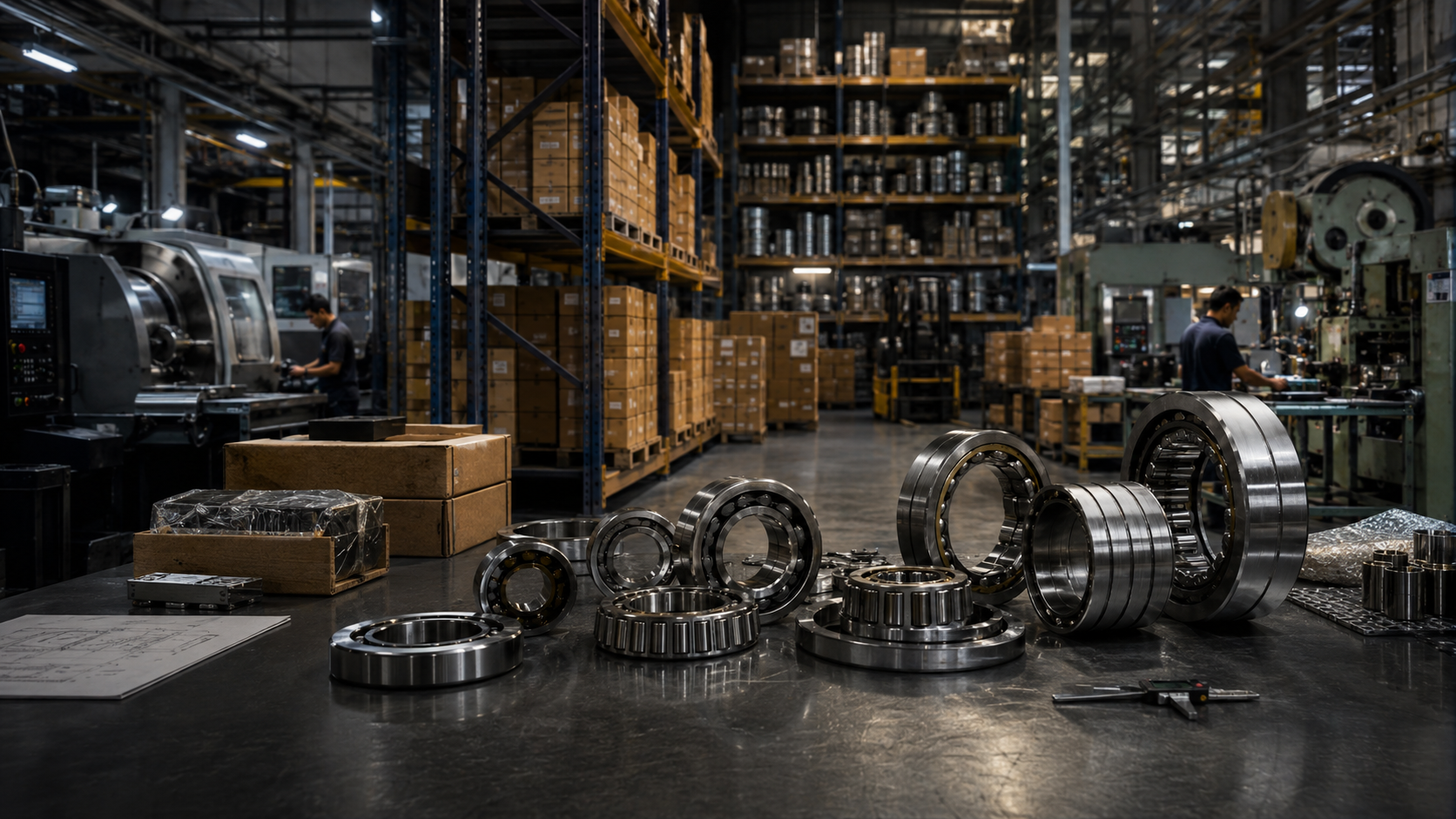
Not every bearing with the same number or dimensions performs identically.
Bearing performance depends on several manufacturing and engineering factors, including:
- Steel quality
- Heat treatment
- Raceway geometry
- Surface finish
- Dimensional tolerance
- Internal clearance
- Cage design
- Sealing arrangement
Before approving an industrial bearing supplier, your procurement or engineering team should verify the exact specification being offered.
Ask the supplier:
- What tolerance class is being supplied?
- Is the bearing P0, P5, P6, or another specified tolerance?
- What radial clearance is provided—CN, C3, C4, etc.?
- What sealing configuration is available?
- What cage material is used?
- Is the bearing suitable for the application’s temperature and operating conditions?
A professional supplier should be able to answer these questions for the actual bearing being quoted.
If the supplier can only provide a generic catalogue without confirming the exact product specification, additional verification may be required.
2. Verify Bearing Authenticity and Traceability
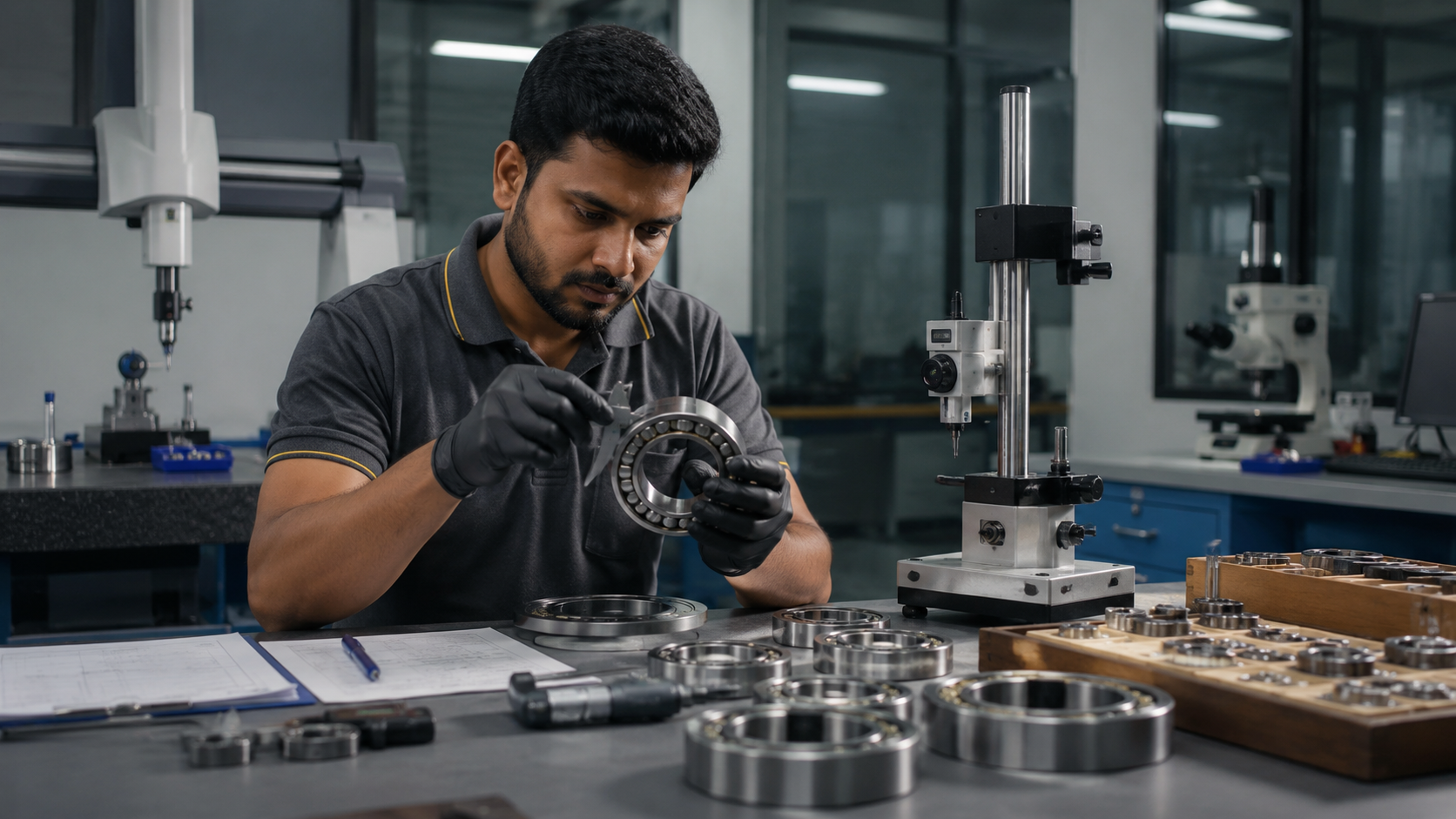
Bearing traceability is one of the most important factors in industrial procurement.
Buyers should be able to understand what product they are receiving and connect that product to the relevant batch and inspection information.
For production-critical applications, purchasing bearings without sufficient traceability can increase quality risk.
Ask your bearing supplier for:
- Dimensional inspection information
- Bore measurement
- Outside diameter measurement
- Width measurement
- Material information
- Radial clearance verification
- Batch identification
- Relevant production or inspection records
Traceability becomes especially important when multiple bearing batches are purchased throughout the year.
If a problem occurs later, batch identification makes investigation significantly easier.
3. Evaluate Batch-to-Batch Consistency
One good sample does not automatically make a supplier reliable.
The real test is whether the same quality is maintained across:
- The first trial order
- The second shipment
- Repeat monthly orders
- Higher-volume requirements
- Different production batches
For industrial buyers, bearing consistency can be just as important as initial bearing quality.
Variations in areas such as dimensional tolerance, internal clearance, hardness, or surface condition may affect equipment performance.
Ask a potential supplier:
How do you control quality between different production batches?
Also ask what inspection or batch records are available for repeat supplies.
The objective is simple:
The bearing approved during supplier qualification should be representative of the bearings received months later.
4. Check Stock Availability and Delivery Reliability
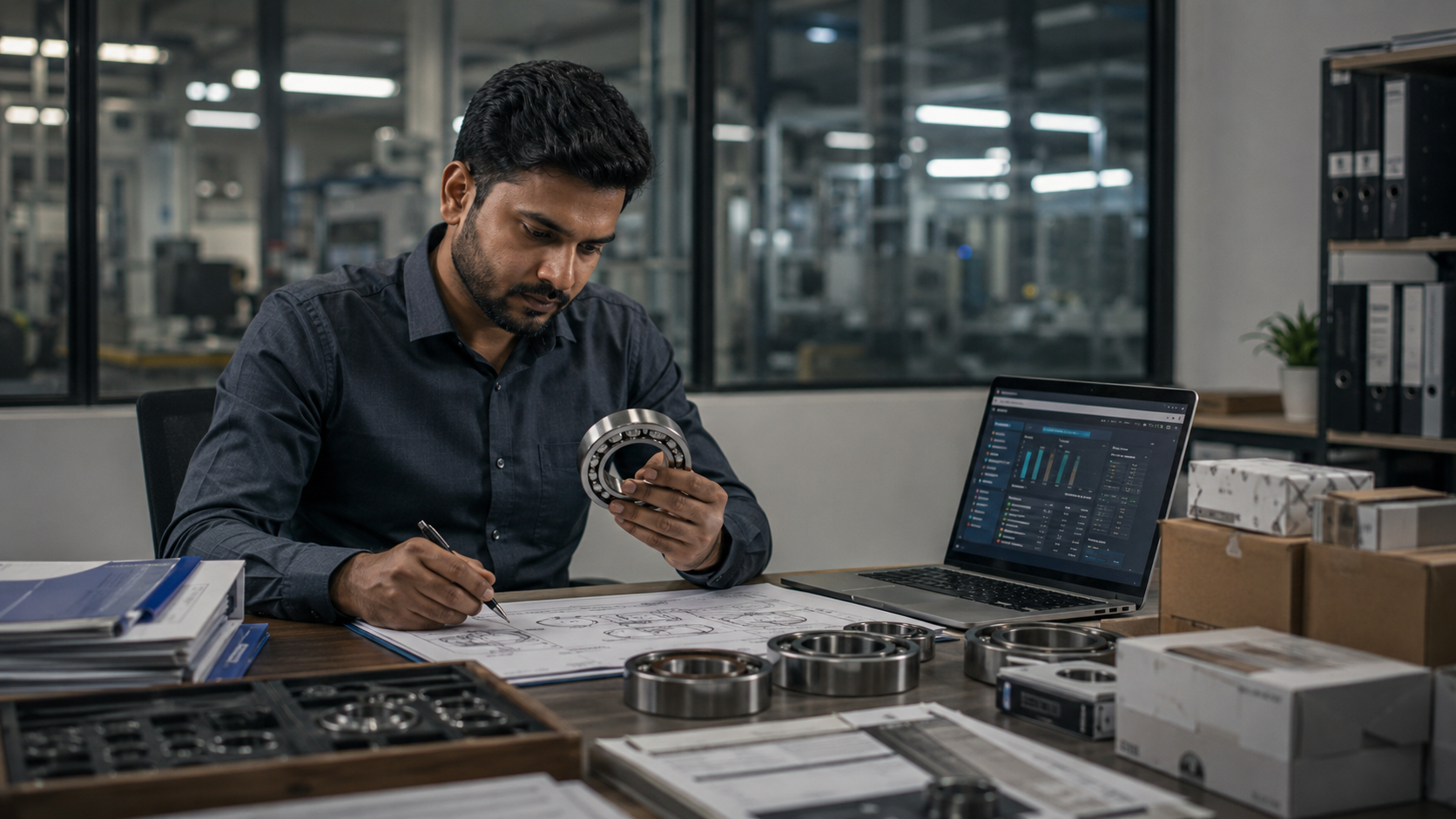
A technically correct bearing is still a problem if it does not arrive when production needs it.
This is why availability should be evaluated separately from product quality.
When comparing a bearing distributor or supplier in India, check:
- Which bearings are physically in stock?
- Which products are available only against order?
- What is the normal dispatch time?
- What is the expected lead time for non-stock items?
- Is safety stock maintained for fast-moving bearings?
- What happens when a committed delivery date cannot be met?
This distinction is particularly important for production-critical bearings.
If a bearing is required during a planned maintenance shutdown, a delay can extend downtime and disrupt the production schedule.
Do not only ask:
“Can you supply this bearing?”
Ask:
“Is this bearing currently available in stock, in what quantity, and what is the realistic dispatch date?”
That gives procurement teams much more useful information.
5. Evaluate the Supplier’s Technical Bearing Knowledge
There is a major difference between a supplier that simply processes purchase orders and one that understands bearing applications.
A technically capable industrial bearing supplier should be able to discuss factors such as:
- Bearing type
- Shaft dimensions
- Housing dimensions
- Radial clearance
- Operating temperature
- Speed
- Load
- Contamination
- Lubrication
- Sealing
- Installation conditions
For example, the supplier should be able to help determine whether:
- A different clearance grade may be required
- A sealing configuration is unsuitable for the operating environment
- An alternative bearing can be used when availability is limited
- An application requires further engineering evaluation
Technical support becomes even more valuable when a bearing fails prematurely.
Instead of simply supplying another bearing, a competent supplier should be able to participate in the discussion around the possible cause of failure.
6. Qualify a New Bearing Supplier Before Giving Large Orders
Moving immediately from quotation to a large-volume purchase increases procurement risk.
A better approach is to qualify the supplier first.
A Simple Bearing Supplier Qualification Process
Step 1: Place a Trial Order
Start with a limited quantity of the required bearing.
This allows you to evaluate both the product and the supplier’s service.
Step 2: Request Documentation
Ask for the relevant inspection, material, clearance, and batch information required for your application.
Step 3: Inspect the Product
Verify important dimensions and specifications against your purchase requirement.
Step 4: Test Technical Capability
Ask an application-related question.
For example:
- Which clearance should be considered for this operating condition?
- What sealing arrangement would be suitable?
- What alternative can be offered if the original bearing is unavailable?
The quality of the answer can indicate how much technical capability exists behind the sales team.
Step 5: Understand the Claims and Returns Process
Do not wait for a problem to discover how the supplier handles complaints.
Clarify:
- Return procedure
- Quality claim procedure
- Inspection process
- Replacement process
- Expected response time
Step 6: Increase Volume Gradually
Once quality, documentation, delivery, and service have been demonstrated, procurement volume can be increased with greater confidence.
Price vs Reliability: What Matters More When Buying Bearings?
Price will always matter in industrial procurement.
But bearing price should be evaluated together with the total cost of ownership.
Consider two suppliers.
One offers a bearing at a slightly lower price but provides limited technical support, uncertain availability, and inconsistent documentation.
Another offers stronger traceability, more reliable delivery, better technical assistance, and consistent quality.
The lowest unit price may not always create the lowest operating cost.
For production equipment, buyers should evaluate:
| Procurement Factor | Why It Matters |
|---|---|
| Bearing quality | Influences reliability and operating life |
| Correct specification | Helps ensure suitability for the application |
| Batch consistency | Reduces variation between repeat orders |
| Traceability | Supports quality investigation and control |
| Stock availability | Reduces procurement and maintenance delays |
| Delivery reliability | Protects maintenance and production schedules |
| Technical support | Helps with selection and application issues |
| Price | Controls direct procurement cost |
A strong procurement decision considers all of these factors together.
Should Industrial Buyers Use More Than One Bearing Supplier?
For certain production-critical requirements, dual sourcing can reduce supply-chain risk.
Instead of depending entirely on one supplier, buyers may qualify:
- A primary supplier
- A backup supplier
Both suppliers should be evaluated against the same technical and documentation requirements.
Before approving the backup source, confirm that the supplied bearing is suitable for the required specification.
Dual sourcing can be especially useful when:
- The bearing is critical to production
- Lead times are long
- Consumption is high
- Equipment downtime is expensive
- Availability regularly fluctuates
The backup supplier should be qualified before an emergency occurs, not during one.
What Documents Should a Bearing Supplier Provide?
Documentation requirements vary by application, but industrial buyers may request information such as:
- Dimensional inspection reports
- Bore, OD, and width measurements
- Material information
- Radial clearance verification
- Batch identification
- Relevant inspection records
For companies with formal quality systems, these records can also support internal vendor evaluation and incoming inspection procedures.
The important point is consistency.
Documentation should not be available only for the first sample and disappear after regular purchasing begins.
How KHS Innovation & Engineering LLP Supports Industrial Bearing Requirements
KHS Innovation & Engineering LLP (KHS-LG) supplies bearings and precision engineering components to industrial buyers across India.
The bearing portfolio includes:
- Deep groove ball bearings
- Angular contact bearings
- Cylindrical roller bearings
- Spherical roller bearings
- Needle roller bearings
- Thrust ball bearings
- Track roller bearings
- Plummer block units
These bearing categories are widely used across industrial applications such as motors, pumps, gearboxes, conveyors, machinery, and processing equipment.
[Internal Link: Explore KHS-LG Bearing Products]
KHS-LG’s approach is focused on combining product supply with engineering knowledge.
For industrial customers, this means the procurement conversation can extend beyond simply asking:
“What is the price?”
and move towards questions such as:
“What bearing is suitable for the application?”
“What specification should be considered?”
“What documentation is available?”
“What alternatives are possible if supply is constrained?”
For industrial buyers looking for a bearing supplier in India that can support product requirements, specifications, and procurement discussions, KHS Innovation & Engineering LLP provides a broad bearing portfolio for multiple industrial applications.
[Internal Link: Contact KHS-LG for Bearing Requirements]
Quick Checklist: How to Choose a Bearing Supplier in India
Before finalising a supplier, check whether you can confidently answer yes to the following:
- Can the supplier confirm the exact bearing specification?
- Can they provide relevant quality documentation?
- Is batch traceability available?
- Is quality consistent across repeat orders?
- Is stock availability clearly communicated?
- Are delivery commitments realistic?
- Can the supplier provide technical support?
- Is there a defined quality-claim process?
- Has a trial order been successfully evaluated?
- Is the overall value better than simply choosing the lowest quotation?
If several answers are no, additional supplier qualification may be necessary.
Conclusion
India has no shortage of bearing suppliers.
The challenge is finding a supplier that can deliver the correct bearing, correct specification, consistent quality, required documentation, and dependable availability over the long term.
For industrial procurement teams, supplier selection should therefore go beyond price.
Evaluate:
Quality → Specification → Traceability → Consistency → Availability → Technical Support → Price
When these factors are considered together, purchasing decisions become more reliable and procurement risk becomes easier to control.
The best bearing supplier in India is not necessarily the company that gives the lowest first quotation.
It is the supplier that continues to perform after the first order.
Frequently Asked Questions About Bearing Suppliers in India
1. How do I choose a reliable bearing supplier in India?
Evaluate the supplier based on product quality, specification accuracy, documentation, traceability, repeat-order consistency, stock availability, delivery performance, and technical support. A trial order can help verify these factors before larger volumes are committed.
2. How can I check bearing quality before placing a bulk order?
Request relevant inspection and product information with the trial order. Verify important bearing dimensions and specifications against your requirement before approving the supplier for regular purchases.
3. What documents should an industrial bearing supplier provide?
Depending on the application, buyers may request dimensional inspection information, material details, radial clearance verification, batch identification, and relevant quality records.
4. What is bearing radial clearance?
Radial internal clearance is the total possible radial movement between the bearing rings before installation. Common clearance designations include CN, C3, and C4. The appropriate clearance depends on the bearing, fit, operating temperature, and application conditions.
5. Is C3 clearance always better than CN?
No. C3 provides greater internal clearance than normal clearance, but it is not automatically better for every application. Bearing clearance should be selected according to operating conditions, shaft and housing fits, temperature, speed, and the equipment manufacturer’s requirements.
6. Why is bearing batch traceability important?
Batch traceability helps connect a supplied bearing to relevant production or inspection information. If a quality issue occurs later, traceability can make investigation and corrective action easier.
7. Should manufacturers use two bearing suppliers?
For production-critical bearings, qualifying a primary and backup supplier can reduce dependency on a single supply source. Both suppliers should be technically evaluated before regular procurement.
8. Is the cheapest bearing supplier always the best option?
Not necessarily. Unit price should be considered alongside quality, specification accuracy, delivery reliability, documentation, availability, and technical support. A cheaper bearing can become expensive if it contributes to downtime or repeated maintenance.
9. What questions should I ask a new bearing supplier?
Ask about tolerance class, radial clearance, sealing, cage material, stock availability, lead time, documentation, batch traceability, quality control, technical support, and the process for handling complaints or returns.
10. Why is technical support important when selecting bearings?
Bearing performance depends on application conditions. A technically capable supplier can help buyers discuss factors such as clearance, fit, sealing, temperature, contamination, and alternative bearing options rather than limiting the relationship to pricing and order processing.

Comments are closed.